Guides
13F Filing Deadline: 2026-27 Due Dates and 5:30 p.m. Cut-Off
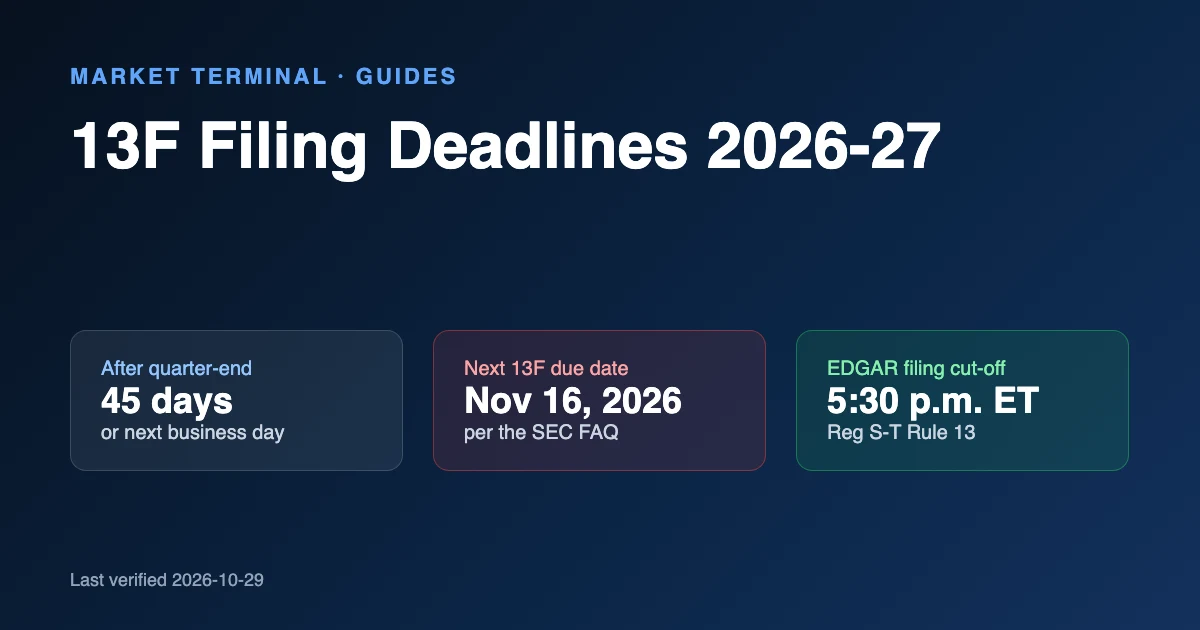
The 13F filing deadline is 45 days after the end of each calendar quarter. When day 45 falls on a Saturday, Sunday or holiday, the report is due on the next business day (SEC Form 13F FAQ). For the next four quarters, that gives Monday, November 16, 2026; Tuesday, February 16, 2027; Monday, May 17, 2027; and Monday, August 16, 2027.
All four day-45 dates land on a weekend, so each report can arrive 47 days after the quarter-end it describes. In the SEC's list of twelve deadlines for 2026 to 2028, these are the four longest gaps (our arithmetic). The SEC publishes the dates. This guide shows the arithmetic so you can check them yourself, then adds what a date list leaves out: the 5:30 p.m. Eastern cut-off, how old the data is when it appears, which EDGAR form type carries which date, and how confidential treatment and amendments move the timeline. To read the holdings once you have the filing, see our guide to reading Form 13F.
Track institutional positions in one place. Market Terminal's Institutions, Insiders & Congress Intel lets you Track Institutional Positions, Insider Buy/Sell Transactions, And Congressional Trades. Check each 13F's period of report and filing date before you rely on it.
Educational note: Educational content only — not investment advice. No earnings claims are being made, any results shown are not typical, and no investment advice is being given. Trading involves substantial risk of loss. Past performance does not guarantee future results. Examples are selected for education and don't represent typical results. We provide screening and charting tools and general market research, not recommendations to buy or sell any security.
How we researched this: on October 29, 2026, the Market Terminal research team read the SEC's Form 13F FAQ (question 25 was updated March 6, 2026), Form 13F and its instructions, Rules 13f-1 and 0-3 under the Exchange Act, Rule 13 of Regulation S-T, the SEC's Form 13F data sets page and readme, EDGAR's Latest Filings page, the OPM federal holiday schedules, and the FINRA and Investor.gov pages on Form 13F. The due-date and data-age arithmetic is ours: we recomputed all twelve deadlines in the SEC's list and all twelve matched. Examples labelled hypothetical are illustrations, not filings.
Key Takeaways
- A Form 13F is due within 45 days after quarter-end, or on the next business day if day 45 is a weekend or holiday.
- The next four due dates are November 16, 2026, February 16, 2027, May 17, 2027 and August 16, 2027. Each is 47 days after its quarter-end (our arithmetic).
- A filing submitted after 5:30 p.m. Eastern is deemed filed on the next business day, so treat 5:30 p.m. as the cut-off on a due date.
- Keep three dates apart: the period of report, the filing date and, for corrections, the amendment date.
- Confidential treatment can hold a position back for up to a year after the required filing date. An amendment follows within six business days after it ends.
Table of contents
- When are 13F filings due?
- How old is 13F data when it is filed?
- What is the difference between the period of report, the filing date and an amendment date?
- Which form type carries which date: 13F-HR, 13F-NT, amendments and 13F-CTR?
- How does confidential treatment change the dates?
- How do 13F dates compare with Form 4 and Schedule 13D and 13G dates?
- Where can you find 13F filings and their dates on EDGAR?
- Where does Market Terminal fit?
- The bottom line
- Frequently asked questions
When are 13F filings due?
Rule 13f-1(a)(1) sets the clock. A manager must file "within 45 days after the last day of such calendar year and within 45 days after the last day of each of the first three calendar quarters of the subsequent calendar year" (17 CFR 240.13f-1). The instructions to Form 13F repeat it.
The weekend rule sits in a different rule. Under Rule 0-3(a), "if the last day on which papers can be accepted as timely filed falls on a Saturday, Sunday or holiday, such papers may be filed on the first business day following" (17 CFR 240.0-3). The SEC's FAQ applies both: "When the filing deadline falls on a Saturday, Sunday or a holiday, then your filing is due on the first business day thereafter."
How do you calculate a 13F due date?
Three steps, and no lookup table:
- Start at the period end. The report period ends on "the last day of the calendar year or quarter, as appropriate" (Form 13F). That is March 31, June 30, September 30 or December 31.
- Add 45 days. Each period ends on the last day of a month, so day 45 always lands on the same calendar date: February 14, May 15, August 14 or November 14. Only the weekday changes from year to year.
- Roll forward if needed. If that date is a Saturday, Sunday or federal holiday, move to the next day and repeat until you reach a business day. We took holidays from the OPM federal holiday schedules.
What are the 13F filing dates for the next four quarters?
| Period of report | Day-45 arithmetic | Why the date moves | Due date | Days after period end |
|---|---|---|---|---|
| September 30, 2026 | Sep 30 + 31 days (October) = Oct 31, then + 14 more days = Saturday, November 14 | Saturday and Sunday are not business days | Monday, November 16, 2026 | 47 |
| December 31, 2026 | Dec 31 + 31 days (January) = Jan 31, then + 14 more days = Sunday, February 14, 2027 | Sunday, then Monday, February 15 is a federal holiday | Tuesday, February 16, 2027 | 47 |
| March 31, 2027 | Mar 31 + 30 days (April) = Apr 30, then + 15 more days = Saturday, May 15 | Saturday and Sunday | Monday, May 17, 2027 | 47 |
| June 30, 2027 | Jun 30 + 31 days (July) = Jul 31, then + 14 more days = Saturday, August 14 | Saturday and Sunday | Monday, August 16, 2027 | 47 |
The arithmetic is ours. The SEC's FAQ lists the same four dates, along with the other eight quarters ending in 2026 through 2028. We ran the three steps above for all twelve and reproduced all twelve.
Why is the February 2027 deadline a Tuesday?
Because the Monday after it is a holiday. December 31, 2026 plus 45 days is Sunday, February 14, 2027. The next day, Monday, February 15, is Washington's Birthday on OPM's 2027 schedule, so the first business day is Tuesday, February 16.
The SEC's FAQ walks through the same case a year earlier. The deadline for the December 31, 2025 report "will be no later than February 14, 2026, a Saturday," and because "Monday, February 16, 2026 is a holiday," it "gets pushed to February 17, 2026, a Tuesday" (SEC FAQ).
What time is the 13F filing deadline?
The cut-off is 5:30 p.m. Eastern. Rule 13(a)(2) of Regulation S-T says filings "submitted by direct transmission commencing on or before 5:30 p.m. Eastern Standard Time or Eastern Daylight Saving Time, whichever is currently in effect, shall be deemed filed on the same business day". Later ones "shall be deemed filed as of the next business day" (17 CFR 232.13).
Rule 13(a)(4) sets a later 10 p.m. cut-off for a short list: Forms 3, 4 and 5, Schedule 14N, Form 144, and Schedules 13D and 13G. Form 13F is not on that list. By our reading, a 13F submitted at 6 p.m. on a due date would carry the next business day's date. The SEC's FAQ does not address that case. EDGAR's Latest Filings page uses the same line, describing "filings made after the 5:30 pm deadline on the previous filing day".
How old is 13F data when it is filed?
The period of report is the last day of the quarter. A report filed on the due date is therefore 47 days old in all four cycles above, which is 6 weeks and 5 days. Across the SEC's twelve-date list, seven deadlines come 45 days after the period end, one comes 46 days after (November 15, 2027) and four come 47 days after. The next four are the four longest (our arithmetic).
A manager can file earlier, because the rule says "within 45 days", so a given report may be younger. Our own 13F guide says a disclosed position "may therefore be more than six weeks old when it becomes public". The dates above put an exact number on that. FINRA gives the same warning: "the lag time means what you see in the filings might be outdated by the time you're able to access the information" (FINRA).
How long can a trade wait before it appears? (hypothetical)
A 13F shows holdings on the last day of a period, so the age of a position when it first appears depends on when it was bought. Take a hypothetical manager that buys a stock on July 1, 2026 and still holds it on September 30. The first 13F that can show the position is due November 16, 2026, which is 138 days after the purchase. A hypothetical purchase on September 30 would appear after 47 days if the report is filed on the due date. The gap is longest for a purchase on the first day of a quarter:
| Hypothetical purchase date | First report that can show it | Due date | Days from purchase to due date |
|---|---|---|---|
| July 1, 2026 | Period ending September 30, 2026 | November 16, 2026 | 138 |
| October 1, 2026 | Period ending December 31, 2026 | February 16, 2027 | 138 |
| January 1, 2027 | Period ending March 31, 2027 | May 17, 2027 | 136 |
| April 1, 2027 | Period ending June 30, 2027 | August 16, 2027 | 137 |
These are our arithmetic and assume the position is still held at quarter-end and the report is filed on the due date. A position bought and sold inside one quarter never appears in that quarter's report.
Hypothetical performance disclosure: This calculation is hypothetical and for educational purposes only. Hypothetical results have inherent limitations, are prepared with hindsight, involve no financial risk, and do not represent actual trading. Actual results will vary. No representation is made that any account will achieve similar profits or losses.
To keep the dates straight, write one audit line for any 13F claim: "Period of report: [date]. Filing date: [date]. Days from period end to filing: [n]. Days from period end to today: [m]. Amendments checked: [yes or no]." Using a hypothetical filing date of November 16, 2026 for the September 30, 2026 period, and opening the filing on December 1, 2026, the two counts are 47 and 62 (our arithmetic).
Hypothetical performance disclosure: This calculation is hypothetical and for educational purposes only. Hypothetical results have inherent limitations, are prepared with hindsight, involve no financial risk, and do not represent actual trading. Actual results will vary. No representation is made that any account will achieve similar profits or losses.
For the wider routine around a stock, see our stock research checklist.
What is the difference between the period of report, the filing date and an amendment date?
| Date | What it marks | Where it appears |
|---|---|---|
| Period of report | The last day of the calendar year or quarter being reported | The cover page line "Report for the Calendar Year or Quarter Ended"; the SEC data field PERIODOFREPORT |
| Filing date | The date the SEC deems the filing made, which is the next business day if it was submitted after 5:30 p.m. Eastern | The SEC data field FILING_DATE, "Filing date with the Commission" |
| Amendment date | The filing date of a later, numbered correction or addition | The cover page boxes "Check here if Amendment" and "Amendment Number"; a form type ending in /A |
The SEC's 13F data sets readme keeps the first two in separate fields, with a third field, SUBMISSIONTYPE, telling an original from an amendment.
Amendments come in two kinds. A restatement resubmits the whole report, and "your amended filing will supersede your original filing" (SEC FAQ). An amendment that "adds new holdings entries" only adds lines to the report already public. Rule 13f-1(a)(2) says "Amendments must be numbered sequentially" (17 CFR 240.13f-1). Reading the holdings in an amended report is covered in our Form 13F guide.
Which form type carries which date: 13F-HR, 13F-NT, amendments and 13F-CTR?
EDGAR uses a different form type for each version of the filing. The SEC's FAQ says "Form types 13F-HR and 13F-NT are EDGAR submission types," with a holdings report and a combination report filed as 13F-HR and a notice filed as 13F-NT. Amendments add "/A". Confidential treatment requests use "EDGAR form types 13F-CTR and 13F-CTR/A" (SEC FAQ).
| EDGAR form type | What it is | Date to check |
|---|---|---|
| 13F-HR | A holdings report (all holdings listed) or a combination report (some listed here, some by another manager) | The filing date against the due dates above |
| 13F-NT | A notice: a cover page only, naming the other managers that report the holdings | The same Form 13F deadline, by our reading. The holdings sit in the other manager's filing, so check that filing's date too |
| 13F-HR/A, 13F-NT/A | A numbered amendment to either | Its own filing date. The FAQ answer on corrections states no due date |
| 13F-CTR, 13F-CTR/A | A confidential treatment request, including the confidential portion | The required filing date, which starts the clock on the hidden holdings |
How does confidential treatment change the dates?
A manager can ask the SEC to delay public disclosure of some holdings. If it does, the public report has to say so: the Summary Page includes a box that is checked "if confidential treatment is being requested for some or all of" the holdings (Form 13F). Four timing rules follow:
- Length. "Filers initially may request confidential treatment for three months, six months, nine months, or one year" (SEC FAQ).
- Start of the clock. "The duration of confidential treatment is measured from the required quarterly filing date" (SEC FAQ). That is the due date, not the day the manager actually files.
- Outer limit. The instructions say the period "may not exceed one (1) year from the date that the Manager is required to file the Form 13F report with the Commission". A manager can ask for more time, but a new request must be filed "at least fourteen (14) days in advance of the Expiration Date" (Form 13F instructions).
- The amendment. "Upon either the denial of a request for confidential treatment, or the expiration of a grant of confidential treatment, you must — within six business days — amend your public Form 13F filing for a given calendar quarter" (SEC FAQ).
Here is how long that can run (hypothetical). Suppose a manager asks for the full year on the report due November 16, 2026. One year from that required filing date is Tuesday, November 16, 2027. Six business days later, counting the first business day after expiry as day one, is Wednesday, November 24, 2027. That count is ours, because the instruction does not define a counting convention. It is 420 days after the September 30, 2026 period of report, so a held-back position can reach the public more than a year after the quarter-end it describes.
Hypothetical performance disclosure: This calculation is hypothetical and for educational purposes only. Hypothetical results have inherent limitations, are prepared with hindsight, involve no financial risk, and do not represent actual trading. Actual results will vary. No representation is made that any account will achieve similar profits or losses.
For a reader, the point is simple: a position you cannot find may be held back rather than sold. Check the Summary Page for the confidential treatment box, and look for a later 13F-HR/A.
How do 13F dates compare with Form 4 and Schedule 13D and 13G dates?
A 13F runs on the calendar. The other ownership filings run on events:
| Filing | Who files | Clock | Source |
|---|---|---|---|
| Form 13F | Institutional investment managers | 45 days after quarter-end, or the next business day | SEC FAQ |
| Form 4 | Insiders: officers, directors and holders of more than 10% of a class | Two business days after the transaction date | SEC investor bulletin |
| Schedule 13D | Holders that cross 5% of a covered class | Five business days after crossing the threshold | FINRA |
| Schedule 13G | Some holders of more than 5% | From five business days after passing 5% to 45 days after the end of the calendar quarter in which it was crossed, depending on the type of investor | FINRA |
That is why a Form 4 can show an insider's trade within days, while a 13F shows a manager's quarter-end positions weeks later. Our guide to reading SEC Form 4 covers insider filings.
Where can you find 13F filings and their dates on EDGAR?
The SEC's Search Filings page offers a company search and a Latest Filings view, which shows "daily filings by form type within the past week". The Latest Filings page says "To limit filing results, enter company name, CIK, or form type." Its listing carries an Accepted timestamp next to the Filing Date, so you can see when a filing arrived relative to the 5:30 p.m. cut-off. Investor.gov gives the same tip for 13F: use Latest Filings and enter 13F as the form type.
For bulk work, the SEC's Form 13F data sets are "updated quarterly". Since March 2024 they are run for the prior three months, "following the end of the months: February, May, August, November". When we checked on October 29, 2026, the newest set listed was June to August 2026, and the page was last updated August 31, 2026. By our reading, filings for the September 30, 2026 period, due November 16, will arrive in the next set, which the SEC runs after the end of November.
Pair the filing dates with the company's own reporting dates. Our guide to using an earnings calendar covers that workflow.
Where does Market Terminal fit?
Market Terminal sells a research terminal. Its homepage describes "Institutions, Insiders & Congress Intel" and says you can "Track Institutional Positions, Insider Buy/Sell Transactions, And Congressional Trades" (Market Terminal homepage). The due dates in this guide come from SEC rules, not from any terminal. Whatever tool you use, check the period of report and the filing date on the SEC filing itself before relying on a figure.
The bottom line
A Form 13F is due 45 days after quarter-end, or on the next business day when that date is a weekend or holiday. The next four deadlines are November 16, 2026, February 16, 2027, May 17, 2027 and August 16, 2027. Each is 47 days after the period it covers, and 5:30 p.m. Eastern is the cut-off for a filing to count that day. Record three dates for any 13F you cite: the period of report, the filing date and any amendment date. Treat a position you cannot find as a question, not as proof the manager sold, because confidential treatment is one reason it may be missing.
Line up filing dates with the company calendar. Market Calendars cover Earnings Dates, Dividend Schedules, Economic Releases, And Fed Meetings. Free Trial For 2 Weeks • Cancel Anytime.
Frequently asked questions
When is the next 13F filing deadline?
Monday, November 16, 2026, for the quarter ending September 30, 2026. The three after it are Tuesday, February 16, 2027; Monday, May 17, 2027; and Monday, August 16, 2027. The SEC lists the same dates in question 25 of its FAQ.
What time is the 13F filing deadline?
5:30 p.m. Eastern. A filing submitted after that time is deemed filed on the next business day under Rule 13(a)(2) of Regulation S-T, and Form 13F is not among the forms with a 10 p.m. cut-off.
Can a manager get an extension on a 13F?
The SEC says no: "We do not grant any extensions," and a filer "should submit your filing as soon as possible after the filing deadline" (SEC FAQ). A filing date later than the due date in the table above is a late filing, by our reading.
How old is 13F data when it is filed?
On the next four due dates it is 47 days old, which is 6 weeks and 5 days (our arithmetic from the SEC's deadline list). A manager can file earlier, so a given report may be younger. FINRA warns that the lag means the filings "might be outdated by the time you're able to access the information" (FINRA).
Do notices and amendments follow the same deadline?
A 13F-NT notice is a Form 13F report type, so Rule 13f-1(a)(1) applies, by our reading. For amendments, the SEC FAQ tells filers to "correct any error(s) and file an amendment" and, in the answer we read, states no due date for corrections. After confidential treatment is denied or expires, the deadline is six business days (SEC FAQ).
How long can confidential treatment delay a position?
An initial request can run for three months, six months, nine months or one year, measured from the required filing date, and the instructions cap the period at one year from that date (SEC FAQ; Form 13F). The instructions also allow a new request filed at least 14 days before the expiration date, so one year is not a ceiling on how long a holding can stay out of the public report.
Sources
- SEC, "Frequently Asked Questions About Form 13F" (question 25 updated March 6, 2026)
- SEC, Form 13F and instructions (PDF)
- eCFR, 17 CFR 240.13f-1
- eCFR, 17 CFR 240.0-3
- eCFR, 17 CFR 232.13 (Regulation S-T, Rule 13)
- SEC, Form 13F Data Sets and its readme (PDF)
- SEC, Search Filings and EDGAR Latest Filings
- Investor.gov, "Form 13F - Reports Filed by Institutional Investment Managers"
- Investor.gov, "Updated Investor Bulletin: Insider Transactions and Forms 3, 4, and 5"
- FINRA, "Institutional Investors and 'Smart Money'" (October 15, 2024)
- OPM, Federal Holidays
- Market Terminal homepage (features and pricing)
Related research guides
- How to Read Form 13F: Institutional Ownership Guide
- How to Read SEC Form 4: Insider Filings Explained
- Stock Research Checklist: 9 Steps for Better Due Diligence
- How to Use an Earnings Calendar Before and After Results
Risk disclosure. Trading and investing involve substantial risk of loss and are not suitable for everyone. Results shown are not typical; individual results vary. Many traders experience losses. Never trade with money you can't afford to lose.
Market Terminal Research